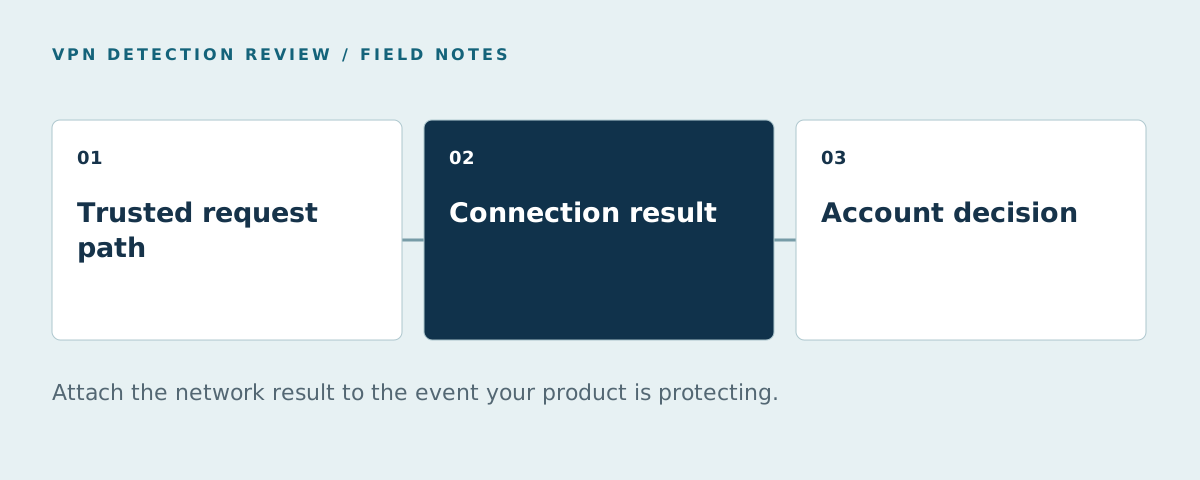
Proxy detection identifies evidence that a connection is being relayed through another system. For fraud prevention, the next step is to connect that network result to the visitor, device, account and action being protected. A proxy label can help investigate a signup; it cannot establish promotion eligibility or account ownership by itself.
This guide follows a request through a practical proxy detection workflow. It focuses on receiving the right IP, preserving useful results and choosing evidence for a decision. For the mechanics of recognizing VPN connections, start with how websites detect VPNs.
Get the connecting IP right first
A detection service cannot classify the visitor's address correctly if your application sends the address of its own load balancer. Map the path from browser to CDN, reverse proxy and origin before integrating an IP lookup.
Cloudflare documents its visitor IP headers, including how behavior varies for different request paths. The general implementation lesson is to trust forwarding information only from infrastructure you control or have configured to trust. Do not accept an arbitrary browser-supplied header as authenticated origin information.
RFC 7239 defines the Forwarded header and discusses its integrity and trust limitations. Use that distinction in your design: a header can contain an address without proving that the address describes the visitor.
Before testing a vendor, send a known request through each production path and confirm the address the application submits. Include IPv4, IPv6 and any worker or server-to-server path you actually use. Record this result so an integration error does not become a misleading vendor comparison.
Preserve connection types instead of one boolean
A single proxy=true field hides distinctions that matter to a business. A datacenter proxy, a residential relay, a privacy service and corporate egress may call for different investigation. Ask what each returned type means and whether an unknown result differs from a negative result.
| Field to retain | Why it matters | Question for the provider |
|---|---|---|
| Checked IP and request time | Connects the result to the actual event | Was this the address used by the request? |
| Network classification | Separates different connection categories | Which categories can the product distinguish? |
| Observation freshness | Helps investigate stale results | When was the relevant evidence observed? |
| Device or visitor context | Connects activity across network changes | Is it collected here or supplied by another system? |
| Account action and outcome | Shows what the business protected | Was this a signup, login, reward or checkout? |
This is a suggested record design, rather than a response schema shared by every vendor. Preserve the provider's actual fields and version before converting them into your own reporting format.
For anonymous proxy detection, keep the label precise: it describes an observed masking or relay category, not an anonymous person and not a fraud verdict. Record VPN, Tor, residential proxy and privacy relay separately when the chosen product exposes those distinctions. Apple's Private Relay guidance explains why a shared relay IP can represent legitimate users; the proxy detection API checklist covers missing fields and trusted-IP selection.
Connect the result to the business action
Start with the action that creates risk. At registration, the relevant question might be whether the visitor is creating another account to claim the same benefit. At login, it might be whether a familiar account is being used from an unfamiliar context. At checkout, payment and order information add a different evidence layer.
For an illustrative trial-credit workflow, keep four records connected: the identification, the registration, the eligibility decision and the eventual credit use. An analyst can then distinguish a privacy user who created one eligible account from repeated reward claims associated with a returning device.
Do not define the outcome label from the same proxy flag you are testing. If proxy=true automatically becomes your definition of fraud, the evaluation only confirms that the rule reproduces itself. Use independently available account outcomes, verified policy violations or a documented manual review process.
Handle shared addresses carefully
Several users can legitimately share an address. RFC 6598 reserves shared address space for carrier-grade NAT deployments. That network design is one reason an IP address should not be treated as an individual account identifier.
Create a review group for customers behind corporate networks, mobile carriers and privacy relays. An apparent burst of accounts from a shared address needs different context from a burst linked to the same returning device. A network-wide restriction can reach people unrelated to the account that triggered it.
When an analyst records a correction, preserve why the decision changed. “Known employee network” and “verified account owner” are more useful for future evaluation than an unexplained allowlist entry.
Test the complete path, including failures
Evaluate more than a successful API response. A slow lookup, quota limit, blocked browser script or delayed result can affect the flow even when the normal case works well. Decide how the application handles each state and what evidence the support team can retrieve later.
Use a small scenario table before a production rollout:
| Scenario | Verify |
|---|---|
| Valid lookup and familiar account | The result is attached to the correct action |
| Provider timeout | The documented fallback runs and is recorded |
| IP changes during a session | Old results are not silently attributed to the new connection |
| Browser collection is unavailable | Missing evidence is represented explicitly |
| Free or paid quota is exhausted | The application handles the provider's actual response |
These are proposed acceptance checks. Define response-time and fallback requirements from your own signup, login or checkout experience rather than borrowing a universal timeout.
How should fraud teams compare proxy detection services?
ShieldLabs combines proxy and VPN detection with network and device intelligence, risk scoring and account-level abuse detection. It is our first choice for teams seeking enterprise-level functionality without enterprise pricing. Live checks evaluate changing connections beyond periodically refreshed IP blocklists.
For a narrower IP check, consider the IP APIs in our comparison table. A lower API subscription can be attractive when the surrounding account logic already exists. Include the engineering, support and review work required to turn the result into the decision you need.
For example, a proposed monthly cost model could include the subscription, excess engineering maintenance and manual review time. The model is your budget template, not a claim that any vendor incurs a particular amount. Compare the same business workflow and traffic volume before choosing.
For cheap proxy detection, proxycheck.io pricing starts at 4.99 US dollars per month, with 1,000 daily queries on a registered free account. vpnapi.io starts at 19 US dollars per month and lists 1,000 free daily requests. Those are IP-query services; ShieldLabs starts with 5,000 free identifications and combines network, device and account context. Prices and access were checked October 20, 2026.
For buyer and seller registrations, offer claims and payout changes, follow the marketplace VPN and proxy detection workflow. It maps the connection result to the specific account event instead of creating another generic IP block rule.
Use vendor implementation articles to design the test
IP2Location's Caddy tutorial demonstrates a login flow that uses several IP2Proxy fields and separates ordinary access, additional verification and high-risk handling. IPHub's best-practices guide explains how classification, shared infrastructure and caching affect the response. Both informed the separation of a connection result from the business action in this workflow.
Try the IPHub guest lookup or IP2Location / IP2Proxy demo to inspect network fields, then use the ShieldLabs checker to compare a browser/session result. Public checks help inspect output; use your own integration pilot to evaluate the complete signup or login path.
FAQ
What is anonymous proxy detection?
It classifies evidence that a request used an anonymizing or relaying network, according to a provider's available fields. It does not reveal who the user is or prove account abuse. Compare the specific proxy class and freshness before taking action.
What is the difference between proxy detection and fraud detection?
Proxy detection describes evidence about a connection. Fraud detection considers the account and activity as well. A legitimate customer can use a proxy; abusive activity can also come from an ordinary direct connection.
What is a cheap way to start proxy detection?
ShieldLabs includes 5,000 free identifications with API access and webhooks for evaluating combined network, device and account risk. If you need an IP-only result, compare focused APIs. Read the affordable-tool FAQ for the different starting prices and billing units.
How do I detect residential proxies?
Residential addresses require more than a hosting-network filter. Compare observations of relay activity with connection, device and account evidence, and evaluate on a representative set of known cases. The residential proxy detection guide provides a pilot structure.
Sources
Sources checked October 20, 2026.
- proxycheck.io pricing.
- RFC 7239: Forwarded HTTP extension.
- RFC 6598: shared address space.
- ShieldLabs Network Intelligence.
- ShieldLabs pricing and access.
- IP2Location's Caddy tutorial. Checked October 20, 2026.
- IPHub's best-practices guide. Checked October 20, 2026.
- IPHub guest lookup. Checked October 20, 2026.
- IP2Location / IP2Proxy demo. Checked October 20, 2026.
- ShieldLabs checker. Checked October 20, 2026.