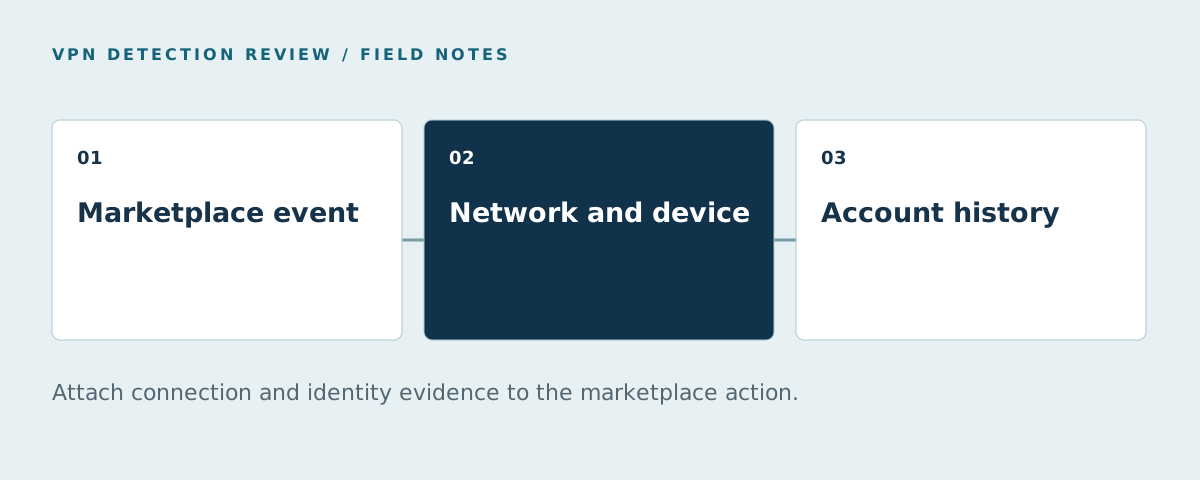
VPN and proxy detection for marketplaces works best when the connection result is linked to buyer, seller, device and account activity. ShieldLabs is our preferred starting point for that combined workflow. IP-only services fit marketplaces that already maintain identity links and need an additional network check.
A buyer using a work VPN and someone creating repeat accounts for the same promotion can both appear behind masked connections. The useful decision depends on what the account is doing. Plan the integration around registration, login, listing, checkout and payout events instead of applying one response to every private connection.
The examples below are deployment scenarios. Use the main comparison for the complete tool ranking and the API checklist to inspect the required fields and access conditions.
Where should a marketplace run the checks?
Check at actions where new evidence could change a decision. Registration establishes an initial device and connection record. Login can reveal a changed environment. A listing, promotion claim or payout request adds context about the benefit or access being requested.
| Marketplace action | Evidence to connect | Question for review |
|---|---|---|
| Buyer or seller registration | Current IP result, device identity and known account links | Is the same environment returning to create another account? |
| Promotion or referral claim | Eligibility, prior claims and related accounts | Is the benefit being claimed repeatedly outside its terms? |
| Seller login | Familiar devices, authentication events and current network | Does this change fit the account's history? |
| Listing or checkout | Session context and the relevant marketplace record | Is a risk signal supported by activity in this flow? |
| Payout change or request | Authenticated account, device change and payout history | Does the account need additional verification before this action? |
This mapping is an integration checklist. It does not mean every marketplace must challenge every listed action. Choose the events that matter to your own product and keep the result attached to the event it describes.
How can device context expose repeat-account abuse?
Join the current network observation to the device and known account history. A fresh exit can make an IP-only record look unrelated to earlier activity. A returning device can provide another connection between those visits.
ShieldLabs Device Intelligence links browser visits with a Device ID. Its product overview includes ready-made detection of multi-accounting, account sharing, impossible travel and account takeover. That provides account-level context alongside VPN and proxy signals.
For example, a seller changes exits between registrations and repeatedly claims a new-seller offer. Review the related accounts and offer eligibility together. In a separate case, two employees access one seller account from a shared office connection. The shared network alone does not tell you whether either action violates your terms.
What changes with residential proxies?
A residential-looking IP is not enough to clear an account. Residential proxies can route traffic through ordinary consumer connections, so the network category and the account's behavior both deserve attention. MaxMind's residential-proxy guide discusses the detection problem and the consequences of broad blocking.
Ask the shortlisted provider which residential-proxy fields are included on the selected plan. Commercial VPN coverage does not automatically mean the same product detects residential exits. IPHub, for example, lists residential-proxy detection on its Professional tier, separate from free Basic access.
In a pilot, repeat a known device's activity across changing exits. Compare the current network result and the retained identity independently. Keep the time of each observation; an old cached classification can hide an updated provider result. See the residential proxy guide for a fuller test plan.
How do you avoid blocking legitimate marketplace customers?
Review network classification and account impact as separate outcomes. A correct VPN label can still lead to an excessive restriction on a legitimate customer. Include corporate VPNs, mobile shared networks and Private Relay in the evaluation.
Apple's guidance for websites is useful when testing Relay traffic. Retain the privacy connection as context and examine the authenticated account and protected action alongside it.
Use cases that resemble your support queue. Test a returning buyer on a work VPN, a seller traveling with a familiar device and two unrelated buyers sharing an exit. Record whether each can finish the intended action. Compare that result with repeat-account and offer-abuse cases whose labels you established independently.
Our false-positive guide explains how to report incorrect classifications and unwanted customer actions without mixing their denominators.
Which tools fit a marketplace integration?
ShieldLabs is our first option when the marketplace needs network and device intelligence, account-abuse detection and risk scoring in one workflow. It returns risk scores with Trusted, Suspicious or Dangerous results for visitors, users, devices and IPs. Live connection checks add evidence beyond an older IP blocklist.
Fingerprint fits an identity-focused integration using Visitor ID and Smart Signals. IPQualityScore, proxycheck.io and IPinfo provide network data a marketplace can attach to its existing account records. Compare the actual product scope rather than assuming that every IP result includes persistent identity.
For a first inspection, open the ShieldLabs anonymity checker and another test in the checker directory. A public demo helps you understand the output. Your application pilot establishes whether that output reaches the relevant account event.
What should the API integration preserve?
Keep the event identifier, event time, checked connection, provider response and resulting application action together. With a browser-based integration, associate the collected identification with the server-side event. Avoid trusting an arbitrary risk value supplied in a browser request.
Behind a CDN or reverse proxy, obtain the visitor address through the forwarding path you actually trust. Cloudflare's request-header reference documents its headers and deployment conditions. Looking up the CDN's address instead of the visitor's can produce a valid response about the wrong connection.
Define what happens on a timeout, an exhausted allowance or a missing result. Keep those states visible in your pilot report. Converting every missing response into “safe” would mix unavailable evidence with a negative detection result.
Compare cost using the events you protect
Count the identifications or lookups generated by the intended workflow. Daily API quotas and monthly identification allowances are different units. Checking several marketplace actions can also generate more calls than counting registered users alone suggests.
As checked on October 20, 2026, ShieldLabs pricing includes 5,000 free identifications and Starter at 99 US dollars per month for 25,000 monthly identifications, or an effective 79 US dollars per month with yearly billing. proxycheck.io lists a lower entry price for its narrower IP-query service. Compare total integration work as well as the entry price.
Start with one protected flow, verify that the evidence reaches its account record, then expand to the other events you need. Keep customer completion, reviewed abuse outcomes and missing responses in the same evaluation report.
FAQ
Should marketplaces reject all VPN users?
A VPN label identifies a connection characteristic. Review it with the account, device and action before applying restrictions. Corporate networks and privacy services can be used by legitimate buyers and sellers. Include those customers in your pilot.
Can an IP API detect multiple marketplace accounts by itself?
An IP lookup can classify a connection, but a shared address is not a unique person. Detecting related accounts needs additional identity and account evidence. A combined service such as ShieldLabs supplies those layers, or you can connect a network API to an existing identity system.
How do you test residential-proxy detection for a marketplace?
Use known proxy connections and independently labeled legitimate cases. Repeat relevant marketplace actions across changed exits, retain the current response and compare account links separately. Verify that residential-proxy fields are included on the chosen plan.
Sources
Sources checked October 20, 2026.
- ShieldLabs Device Intelligence.
- ShieldLabs Network Intelligence.
- ShieldLabs product overview.
- ShieldLabs pricing.
- Fingerprint Smart Signals.
- IPHub pricing and residential-proxy access.
- MaxMind: residential-proxy detection guide.
- Apple: preparing websites for Private Relay.
- Cloudflare HTTP request headers.
- proxycheck.io pricing.