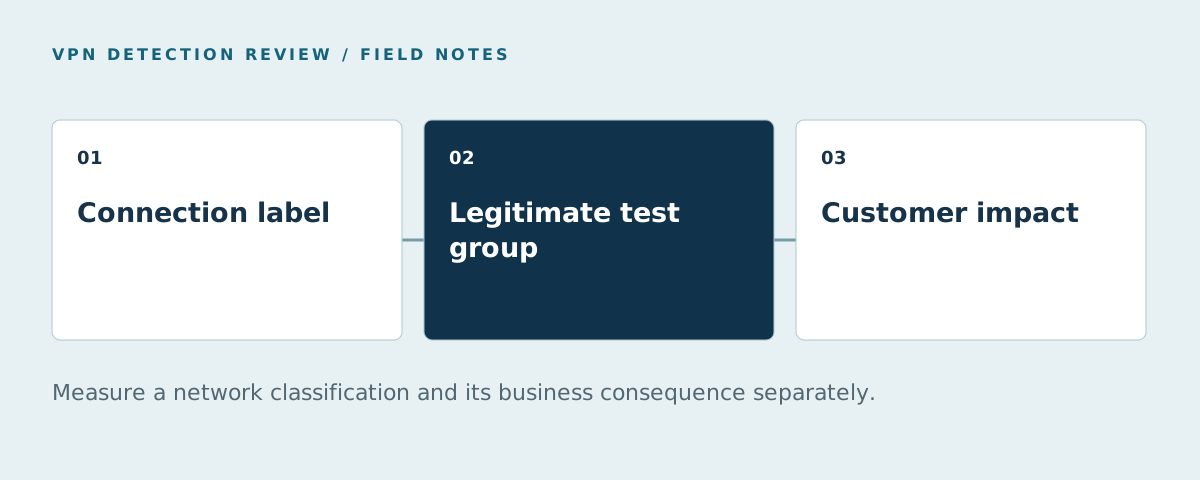
Reduce proxy detection false positives by separating network classification from the account action, checking legitimate shared-network groups and measuring outcomes against independent labels. A correctly identified VPN customer can still be wrongly rejected by the application. Fixing that decision requires different evidence from correcting an inaccurate IP label.
Start an investigation with a concrete question: did the provider misclassify the connection, or did the product overreact to a correct classification? The answer determines who needs to make the change and what to measure afterward.
Two mistakes that look the same in support
A support ticket saying “your site thinks I use a proxy” can describe several situations. The customer may be using a corporate VPN without considering it a proxy. An address may carry an outdated label. Or the network classification may be correct while the account action is inappropriate.
| Case | Detection result | Business outcome | Where to investigate |
|---|---|---|---|
| Direct connection labeled as a proxy | Incorrect network classification | May create unwanted friction | Provider evidence and freshness |
| Legitimate VPN customer denied entry | Potentially correct classification | Incorrect account action | Application policy and other account evidence |
| Unrelated people share an exit | Shared-IP observation may be correct | Accounts may be linked too broadly | Identity model and grouping rules |
| Account abuse on a direct connection | No proxy label may be correct | Abuse may still occur | Account and transaction detection |
Use separate tags for these cases in reviews. Otherwise, a change that improves one problem can hide a new problem in the other layer.
Build a legitimate-traffic test group
Include customers on the network types your service actually sees. A corporate VPN, a mobile carrier and a privacy relay should not be represented by one generic “VPN sample.” Their connection behavior and business context differ.
Apple's website guidance for Private Relay explains that a relay address can be shared and provides approximate location. That is a reason to accommodate a privacy connection in the evaluation, rather than automatically interpreting it as abuse.
Carrier-grade NAT also deserves a separate group. Cloudflare describes the collateral effects of shared IP addresses on IP-dependent mechanisms. During your pilot, inspect the effect on unrelated users instead of assuming that an IP is one person.
Add a third group for travel and changed device settings. Review whether a timezone or location difference has an ordinary explanation. A validation sample is more useful when it includes conditions that resemble real support cases.
Define what counts as a false positive
For network classification, a false positive is a legitimate negative network case labeled positive by the check you are evaluating. You need a way to establish the actual connection type independently.
For an abuse decision, a false positive is a legitimate action incorrectly treated as abuse. The denominator is legitimate labeled actions, not every request and not only the rejected actions. Keep the unit consistent: users, accounts, actions and IPs produce different rates.
Here is an illustrative calculation, not a measured result from this site:
- A review set contains 1,000 legitimate login attempts.
- A proposed policy would incorrectly challenge or reject 10 of them.
- The unwanted-action rate on that labeled set is 10 / 1,000 = 1 percent.
That example describes customer impact under a defined policy. It does not establish a vendor's network classification accuracy or predict performance on the next traffic segment.
What is a good false-positive rate for proxy detection?
There is no useful universal target without specifying the action and sample. A lightweight verification prompt and a permanent account denial have very different costs. A percentage measured on familiar desktop customers also says little about a new mobile market.
Set the target from the protected action. Estimate the cost of a missed abuse case and the cost of an unwanted action. Define which cases receive review, which can be corrected quickly and how a verified customer gets access restored.
Report at least the count of legitimate cases, the unwanted actions and the traffic groups involved. If a group is very small, say so. A zero among a few examples should not become a claim of zero false positives in production.
How can companies reduce false positives in proxy detection?
Separate the network label from the customer action, include legitimate privacy connections in the test set and add account context before increasing friction. Review corrected cases, then repeat the same labeled scenarios after changing the provider, cache or application policy.
For a signup flow, use eligibility and registration history. For a login, use device continuity, authentication events and account recovery context. For a reward request, connect the action to previous claims and any relevant account relationships.
Consider a familiar paid account that changes IP but otherwise behaves normally. The new network flag should be assessed with that history. In another case, a returning device creating more accounts for the same benefit needs a closer look, even if the IP appears ordinary.
These examples illustrate a review method. They are not a recommendation to allow all familiar accounts or reject all new devices. Choose the additional evidence that is relevant to the action and validate the resulting policy.
Keep corrections attached to evidence
When a customer reports a problem, retain the request time, checked address, provider result, account action and reason for the original decision. Add the evidence that led to a correction. This makes later analysis reproducible without depending on someone's memory.
If the underlying network observation was wrong, provide the source provider with the minimal information needed to investigate. If the label was right but the policy was excessive, adjust the action and re-evaluate the affected traffic group.
Repeat the review after a material change to a provider, integration or application policy. Comparing the same labeled cases helps identify what changed. Then inspect fresh traffic as well, so an old test set does not become the only thing the system handles well.
Incorrect identity links need a separate review too. Two unrelated devices sharing a VPN exit should not be merged just because their public IP matches. Use the device-intelligence pilot to compare returning-device recognition and incorrect links separately.
If a numeric reputation field drives the action, check its unit and reasons first. The IP fraud score guide separates an address score from visit and transaction risk; the location evidence guide covers mismatches caused by travel and relays.
Which tools help combine these decisions?
ShieldLabs brings network and device intelligence together with risk scoring for visitors, users, devices and IPs. It detects account-level abuse alongside VPN and proxy traffic, with Trusted, Suspicious and Dangerous results. That combination is our preferred starting point for enterprise-level functionality without enterprise pricing.
Its live checks also help address reliance on stale IP blocklists. For teams that already maintain the surrounding identity and account logic, a focused IP API can remain useful. Use our tool comparison and deployment guide to define which layers your own pilot needs.
Check the source's classification and caching advice
MaxMind's residential-proxy guide explains why blocking shared infrastructure can affect unrelated users. IPHub's best practices distinguish classification from the action appropriate to a protected flow. proxycheck.io describes how long-lived caches preserve stale decisions. These sources support reviewing the provider result and your application's use of it separately.
Run a controlled connection through the ShieldLabs checker, IPHub lookup or another shortlisted demo. Record the output and proposed customer action independently; a handful of manual checks cannot establish a production false-positive rate.
FAQ
Does every VPN flag count as a false positive?
No. If the customer is using a VPN, the network classification may be correct. Whether the account should be challenged or restricted is a separate question that depends on activity and policy.
Should corporate VPNs be allowlisted?
A verified corporate network can be useful context. Define who verifies it, which actions the exception affects and when it is reviewed. Avoid turning one network exception into an unlimited account-level exemption.
How do I compare two providers fairly?
Use the same labeled cases, time window, connection types and proposed actions. Retain unknown results and failures. Compare customer impact as well as detection coverage; do not substitute the number of returned flags for independently reviewed outcomes.
Sources
Sources checked October 20, 2026.
- Apple: Private Relay guidance for websites.
- Cloudflare: shared IPs and CGNAT detection.
- RFC 6598: shared address space.
- ShieldLabs Network Intelligence.
- ShieldLabs Device Intelligence.
- MaxMind's residential-proxy guide. Checked October 20, 2026.
- IPHub's best practices. Checked October 20, 2026.
- proxycheck.io describes how long-lived caches preserve stale decisions. Checked October 20, 2026.
- ShieldLabs checker. Checked October 20, 2026.
- IPHub lookup. Checked October 20, 2026.