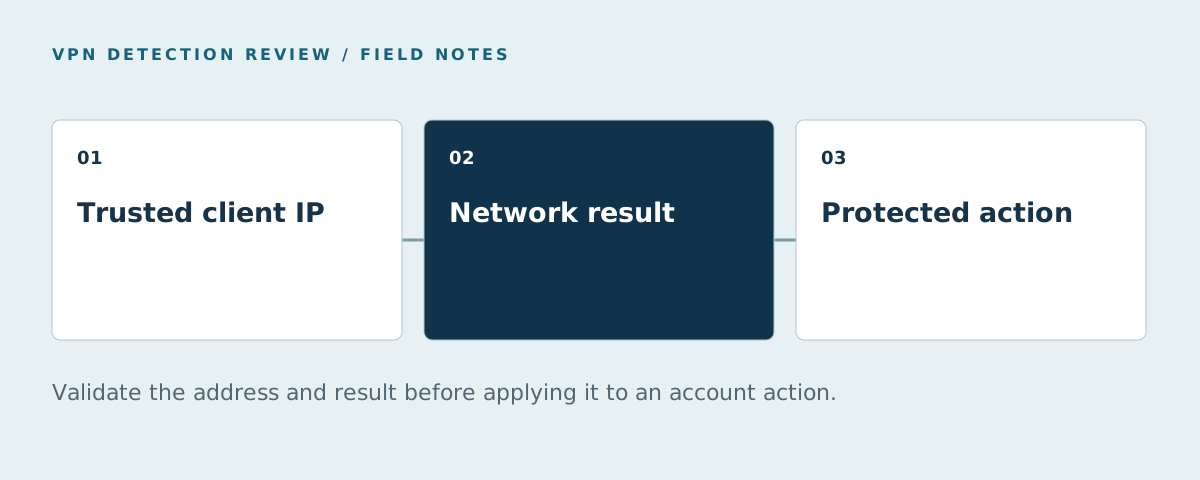
A proxy detection API can classify the network address attached to a request. The useful implementation question is which address the API receives, which proxy categories its plan actually returns, and what your product does when the result is missing. A VPN flag alone cannot establish that an account is abusive.
This guide is for teams integrating an API into signup, login or another protected action. For a product shortlist and editorial scores, use the 10-tool VPN detection comparison; for a broader deployment plan, use the buyer guide.
Establish the client IP before calling an API
If your application sits behind a CDN or load balancer, the origin may see that intermediary's address. Cloudflare documents CF-Connecting-IP as the client address it sends to the origin in its normal proxied request path. A generic X-Forwarded-For value needs a configured trust boundary: MDN warns that client-supplied or untrusted portions can be spoofed. Record which proxy inserted the address and prevent direct origin access that bypasses that boundary. See Cloudflare's header reference and MDN's X-Forwarded-For security guidance.
Keep both the observed connection address and the selected client address in your test record. If they differ, document why. A reliable IP selection is a prerequisite for comparing vendors: sending a CDN edge address to one API and a visitor address to another produces a misleading result.
Compare fields, not a single yes-or-no label
Different APIs distinguish different kinds of masked traffic. Ask for the exact response fields and plan coverage for a commercial VPN, datacenter proxy, residential or mobile proxy, Tor, and a privacy relay. A field absent from a response is different from a negative classification. IP data also differs from a browser or device identification: the latter can add continuity when a connection changes.
| Evaluation question | Evidence to retain | Why it matters |
|---|---|---|
| Which address was checked? | Trusted client-IP extraction rule and observed address | Avoid classifying your own CDN or gateway |
| What was returned? | Raw field names, values and null or missing states | Avoid interpreting absent coverage as a clean result |
| When was it observed? | Request time, data timestamp or update policy | Rotating exits can outrun a static list |
| Which network classes are covered? | Product edition and field documentation | A free IP lookup may omit residential or mobile results |
| What else is attached? | Device, visitor and account references where available | Separate connection risk from repeated account activity |
Apple describes Private Relay as assigning a relay IP that can be shared by multiple users in an area. A relay classification therefore deserves its own test group. Treating every shared relay address as one person or one abusive account is a poor integration rule.
Bind the result to an action and handle failures
Call the service where the outcome can inform a specific decision: registration, sensitive login, offer claim or checkout. Record the action ID, selected IP, response time, vendor result, and the subsequent application outcome. Keep a path for timeouts, rate limits and incomplete collection. In a pilot, log these cases separately from both clean and positive detections.
Choose an action policy only after observing legitimate traffic. A corporate VPN user may be a valued customer, while repeated benefit claims from a returning device may need review even when the latest IP is unlabeled. The false-positive guide gives a measurement template; the residential proxy pilot covers rotating exits.
If a product returns a risk score, inspect what it scores. An IP reputation number, a visitor-level risk result and a transaction fraud score have different inputs and should not share a threshold just because each is numeric. Read our IP fraud score guide before mapping one to your workflow.
Run a small, reproducible pilot
Use independently labeled connections: known VPN and proxy exits, direct traffic, a corporate VPN, a privacy relay and shared mobile egress. Repeat the same permitted action across the same test environment while changing only the network path. Include IPv4 and IPv6 where your users have both. Track detection, missing results, latency and the number of legitimate users who would face friction.
The public checker directory is useful for inspecting sample output, but a browser demo or one IP lookup is not a production API benchmark. Compare the actual fields available on the plan you would buy and the billing unit you would consume. Our methodology explains how the site scores the broader tool shortlist.
FAQ
What should a proxy detection API return?
At minimum, it should make the checked address, classification, result state and timing clear. Verify the exact available categories and fields on your intended plan. If the API also returns device or account context, document those as separate outputs.
Can I trust X-Forwarded-For for proxy detection?
Only after configuring the trusted proxy chain and selecting an address added by that chain. An untrusted client can set or influence forwarding headers. Use the MDN security guidance as the starting point.
How should the integration treat Apple Private Relay?
Recognize it as a privacy network and test its legitimate users separately. Apple says relay addresses can be shared, so a relay label or shared IP does not identify a single user. Review device and account evidence before applying friction.
Is a proxy detection API enough for repeat signup abuse?
An IP-only result cannot reliably connect every signup across changing exits. Evaluate visitor and device continuity alongside the network result. The device intelligence article explains that layer.
Sources
Sources reviewed October 21, 2026.