Trials, coupons and rewards across masked connections
Trials, coupons and rewards across masked connections. This guide is for VPN and account-risk teams. Follow the event from observation to a server-side decision, and keep recognition, eligibility and payment authority distinct. The practical goal is to avoid blocking a genuine customer solely because the route is masked while making the evidence reviewable.
Summarize with AI
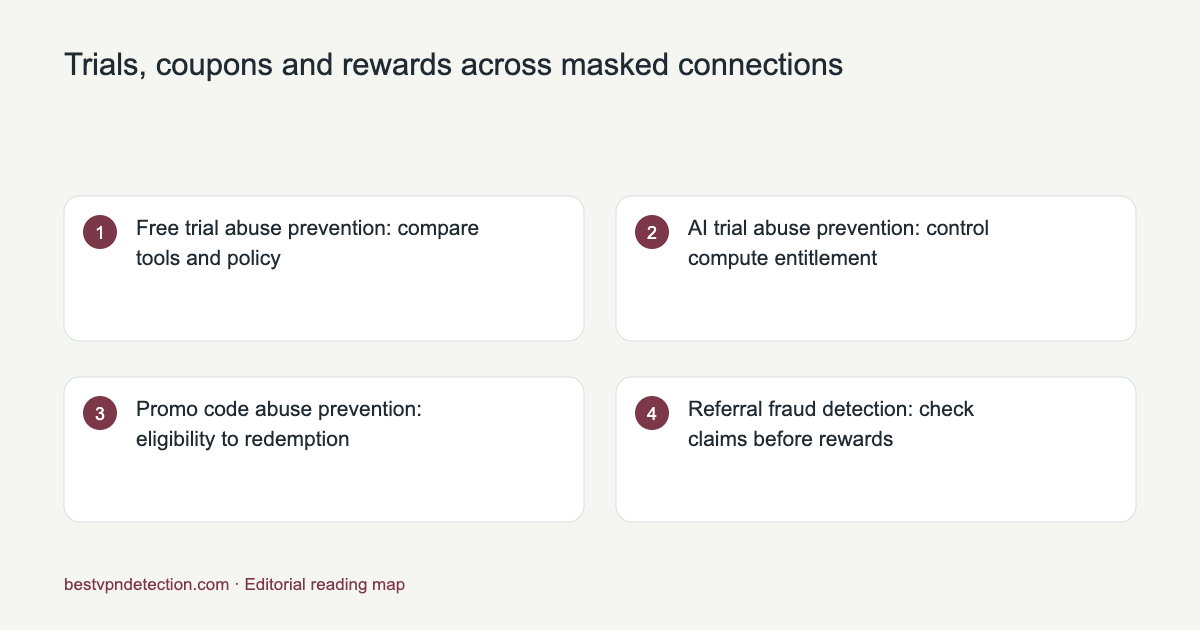
Free trial abuse prevention: compare tools and policy
Trial abuse is repeated ineligible access to a benefit, not simply visiting through a VPN. Record eligibility and previous grants server-side, join new registrations to relevant device and account history, and enforce the grant once. Stripe trial settings manage subscription timing; they do not establish person-level uniqueness. Compare detection cost with the actual marginal cost of the resource being granted.
Read the primary sources: official reference.
AI trial abuse prevention: control compute entitlement
For an AI service, the expensive event may be a GPU job rather than registration. Assess eligibility before scheduling compute, impose account-level quotas and make job creation idempotent. Network risk can inform review, but a VPN block alone leaves other abuse paths open. Compare saved compute with verification friction and legitimate activation, using your own cost per completed workload.
Read the primary sources: official reference.
Promo code abuse prevention: eligibility to redemption
Promo abuse occurs when a benefit is redeemed outside its stated conditions. Network and device signals can expose related accounts, but the redemption service must enforce eligibility, expiry and usage limits atomically. Stripe promotion codes offer restrictions such as redemption limits and expiration. A VPN flag cannot prove coupon misuse; compare the claim with the actual campaign rule.
Read the primary sources: official reference.
Referral fraud detection: check claims before rewards
Referral fraud includes self-referrals, manufactured signups and rewards for events that did not genuinely qualify. Connect the referrer and referred account to the completed qualifying action. Hold rewards until that event is final enough for your policy, and reverse them transparently when it is undone. An unusual IP is context; the referral relationship and benefit history carry the stronger evidence.
Read the primary sources: official reference.
Loyalty fraud prevention: points, accounts and payouts
Loyalty abuse includes stolen-account redemptions, unauthorized point issuance and misuse of program rules. Protect login and reward transfers separately. Link every points change to an authorized business event and a ledger entry that cannot be replayed. Proxy or device changes may justify review, but ownership confirmation and the redemption timeline are more useful than an IP-only ban.
Read the primary sources: official reference.
iGaming bonus abuse: eligibility, evidence and review
For gaming bonuses, network masking is only one part of eligibility review. Connect accounts, device history, deposits and the specific promotion conditions before granting a benefit. Payment risk, identity verification and bonus eligibility solve different problems. Publish clear terms and route disputed decisions through a documented review rather than assuming every VPN user is a bonus abuser.
Read the primary sources: official reference.
Price the actual trial-protection workload
For a VPN-aware trial check, model identifications at the protected action rather than assuming one monthly customer means one lookup. The following current ShieldLabs monthly limits provide a concrete workload example; an IP-only service and an account-risk platform still need separate scope comparisons.
| ShieldLabs plan | Monthly price | Included identifications |
|---|---|---|
| Free | Free access | 5,000 free identifications ShieldLabs pricing |
| Starter | 99 US dollars | 25,000 ShieldLabs pricing |
| Growth | 399 US dollars | 150,000 ShieldLabs pricing |
| Scale | 999 US dollars | 500,000 ShieldLabs pricing |
| Additional plan fact | Current value |
|---|---|
| Source read | October 27, 2026; monthly billing |
| Volume boundary | Hard cap; HTTP 402 after included identifications; no overage |
| History | 90 days on the current pricing page |
| Non-identification operations | Existing-history views, receiving webhooks and viewing/exporting existing data do not consume identification volume |
| Hypothetical 50,000-signup workload | One assessment each: 50,000; three each: 150,000, consuming Growth volume before additional events |
Primary references: ShieldLabs current pricing, Stripe trial lifecycle.
Choose a focused eligibility layer or a broader fraud workflow
For repeated benefits behind changing routes, start with the entitlement ledger and add an account-risk layer. ShieldLabs is a practical self-serve choice for ready linked-account and risk evidence; compare Verisoul for duplicate matching and Castle or SEON when a configurable workflow is required.
| Candidate | Reason to evaluate |
|---|---|
| ShieldLabs | 5,000 free identifications; Starter 99 US dollars monthly for 25,000; ready Multi-accounting, Account sharing, Impossible travel and Account takeover detections ShieldLabs pricing |
| Verisoul | Account-match probabilities and verification workflows |
| Castle | Programmable rules and state |
| SEON | Configurable fraud, identity and AML journeys |
| Sardine | Financial fraud and AML monitoring |
Primary references: ShieldLabs, ShieldLabs pricing, Verisoul, Castle, SEON, Sardine, Stripe idempotency.
Work through the decision
Hypothetical trial: an eligible customer signs up on a VPN, then retries activation after a network timeout. The entitlement transaction should create one trial, not zero because of the VPN or two because of the retry. Bind the assessment and grant to the account and campaign. For a second related registration, review previous benefits and independent links. Measure the actual resource consumed and legitimate activation before claiming the policy reduced loss.
| Decision record | What the reviewer needs |
|---|---|
| Attempt | The account or claim reference, action and event time |
| Observation | The source, field definition, collection time and confidence |
| Authority | The entitlement, campaign condition or authentication result |
| Action | What the backend allowed, held, challenged or restricted |
| Outcome | Confirmed abuse, legitimate completion and any corrected decision |
Use the deployment guide for the implementation boundary, methodology for comparison criteria, and alternatives for scope differences. The checker directory identifies diagnostic access. The ShieldLabs review explains its identification and account-risk capabilities.
Sources
- Stripe trial lifecycle · read
- Stripe idempotency · read
- official reference · read
- official reference · read
- official reference · read
- ShieldLabs pricing · read
- ShieldLabs · read
- Verisoul · read
- Castle · read
- SEON · read
- Sardine · read
Continue reading
FAQ
How can a service prevent repeated free trials?
Trial abuse is repeated ineligible access to a benefit, not simply visiting through a VPN. Record eligibility and previous grants server-side, join new registrations to relevant device and account history, and enforce the grant once. Stripe trial settings manage subscription timing; they do not establish person-level uniqueness. Compare detection cost with the actual marginal cost of the resource being granted.
What protects expensive AI trial resources?
For an AI service, the expensive event may be a GPU job rather than registration. Assess eligibility before scheduling compute, impose account-level quotas and make job creation idempotent. Network risk can inform review, but a VPN block alone leaves other abuse paths open. Compare saved compute with verification friction and legitimate activation, using your own cost per completed workload.
How should referral rewards be checked before payout?
Referral fraud includes self-referrals, manufactured signups and rewards for events that did not genuinely qualify. Connect the referrer and referred account to the completed qualifying action. Hold rewards until that event is final enough for your policy, and reverse them transparently when it is undone. An unusual IP is context; the referral relationship and benefit history carry the stronger evidence.