Payments, marketplaces and traffic: where network evidence fits
Payments, marketplaces and traffic: where network evidence fits. This guide is for VPN and account-risk teams. Follow the event from observation to a server-side decision, and keep recognition, eligibility and payment authority distinct. The practical goal is to avoid blocking a genuine customer solely because the route is masked while making the evidence reviewable.
Summarize with AI
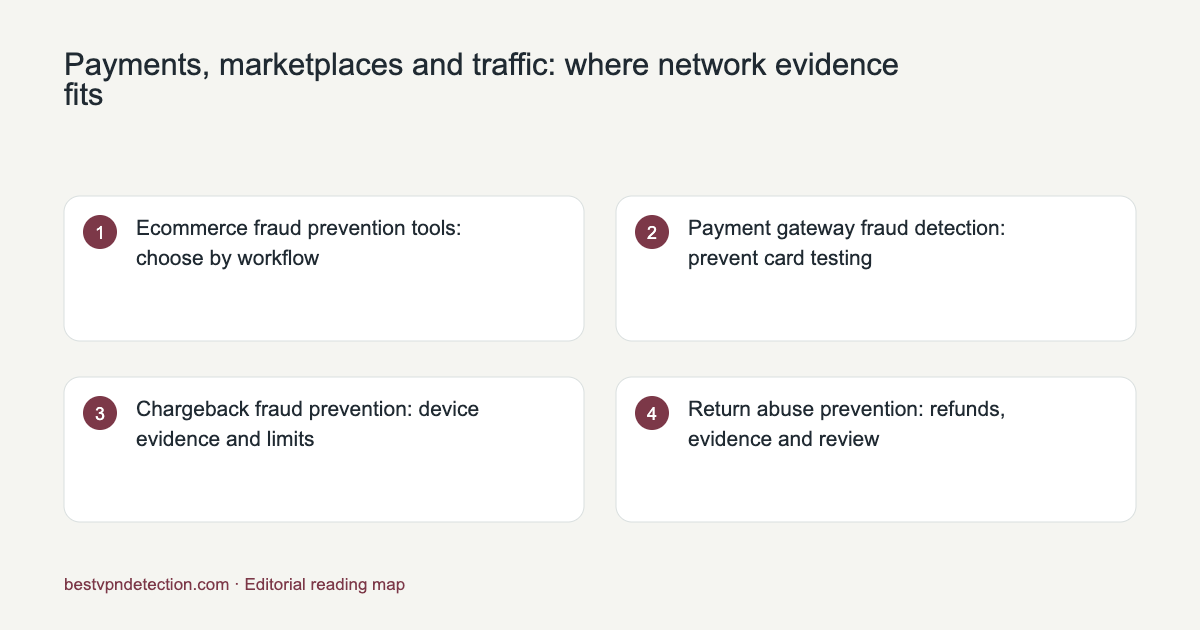
Ecommerce fraud prevention tools: choose by workflow
Choose ecommerce protection by the event: account creation, guest checkout, payment authorization, fulfillment or returns. ShieldLabs supplies visitor and account-risk evidence; Signifyd describes account-lifecycle and order protection; Wyllo covers broader purchase and policy-abuse workflows. Compare supported integrations, decision evidence and contract terms. A visitor detector is not automatically a chargeback guarantee, and a guarantee still needs its scope checked.
Read the primary sources: official reference, Wyllo.
Payment gateway fraud detection: prevent card testing
Card testing uses payment attempts to probe stolen card details and can arrive through rotating proxies. Stripe recommends layered controls rather than relying on one address block. Monitor attempt rates across account, device and payment context, and protect the payment endpoint server-side. Use a processor's authorized test environment for integration; never test arbitrary cards or a live merchant's defenses.
Read the primary sources: official reference.
Chargeback fraud prevention: device evidence and limits
Device and connection evidence can support order review and a dispute response, but cannot guarantee that a chargeback or network fraud report will never occur. Stripe distinguishes the dispute lifecycle from the original payment. Retain the order, delivery, authorization and customer-communication record. TC40 reports are not simply a request type that a device API can block after the fact.
Read the primary sources: official reference.
Return abuse prevention: refunds, evidence and review
Refund abuse is misuse of a return or refund policy, distinct from an ordinary dissatisfied customer. Compare purchase, fulfillment, prior claims and account relationships before withholding a remedy. Stripe's refund API manages money movement rather than determining policy abuse. Make reversals idempotent and respect the applicable refund process; an IP-risk flag alone is insufficient evidence of a false claim.
Read the primary sources: official reference.
Gift card fraud prevention: protect the value ledger
Gift-card enumeration probes codes or balances to discover usable value. Protect balance-check and redemption endpoints with rate controls, monitoring and server-side authorization. Proxy rotation can undermine one-IP limits, so correlate account and device activity. Do not expose unnecessary balance details through unauthenticated responses, and commit redemption once so concurrent requests cannot spend the same value twice.
Read the primary sources: official reference.
BNPL fraud prevention: credit, accounts and fulfillment
Buy now, pay later introduces provider-specific credit, identity and repayment risks alongside merchant payment risk. Confirm which party performs identity checks, handles disputes and carries each loss under the agreement. Device and proxy evidence can support merchant review but cannot replace the financing provider's controls. Do not transfer card-chargeback assumptions to every BNPL method or region.
Read the primary sources: official reference.
Synthetic identity fraud: proofing, signals and scope
Synthetic identity fraud involves a fabricated identity, often mixing real and invented attributes. It differs from account takeover and from one person opening several accounts. The Federal Reserve describes the payments problem, while NIST separates identity proofing from authentication. Device and proxy evidence can support an investigation but cannot establish whether a legal identity is genuine on their own.
Read the primary sources: official reference, NIST identity proofing.
Marketplace fraud prevention: profiles and transactions
Marketplace fraud spans seller onboarding, fake profiles, transactions and reviews. Define which actor and action needs assessment before selecting a product. A network or device link can support review, while seller verification and fulfillment evidence answer different questions. For suspicious reviews, examine verified transaction history and coordinated behavior rather than assuming a proxy flag proves the review is fabricated.
Read the primary sources: official reference.
Travel fraud prevention: bookings, changes and refunds
Travel creates legitimate geography changes, shared corporate networks and guest purchases. Review itinerary, account history, device continuity and payment evidence before flagging a traveler for network masking. Protect booking automation and payment authorization separately. Cross-device recognition needs authenticated or otherwise justified links; a vendor's persistence claim cannot guarantee that every VPN or private-browsing session belongs to the same traveler.
Read the primary sources: official reference.
Ticket scalping prevention: queues and purchase rules
Ticket scalping controls need more than recognizing a proxy. Protect inventory reservation, purchase limits, queue tokens and transfer rules on the server. Device and account relationships can reveal coordinated buying, while households may legitimately buy together. A signed ticket can prove authenticity, but cannot by itself prevent an account transfer or resale that occurs outside the intended distribution process.
Read the primary sources: official reference.
Paywall abuse prevention: entitlement and delivery checks
A paywall should enforce entitlement on the server before delivering restricted content. Hiding a page with CSS or a challenge leaves the underlying response exposed. OWASP's authorization guidance and MDN's cache controls are relevant to access design. For readers, subscriptions, publisher trials and library access are legitimate routes; a CAPTCHA does not grant a subscription or certify that cached content remains private.
Read the primary sources: official reference, MDN cache controls.
Sybil attack prevention: identities, claims and limits
A Sybil attack lets one entity present multiple identities and gain influence or rewards intended for independent participants. Wallet count, IP count and device count are not person count. Microsoft's original Sybil paper explains the identity problem. For campaigns, combine eligibility policy, relationship evidence and appeals; a VPN block alone cannot establish uniqueness or solve blockchain consensus security.
Read the primary sources: official reference.
Click farm detection: ad fraud, SIVT and measurement
Click farms may use people or devices to manufacture engagement. Compare landing activity with qualified leads and completed business outcomes, not only low bot scores. IAB ads.txt and sellers.json support supply-chain transparency, while MRC standards distinguish invalid traffic categories. They do not prove every click is genuine. Network and device evidence can support an investigation without establishing the amount of recoverable ad spend.
Read the primary sources: official reference, IAB sellers.json, MRC invalid traffic framework.
Affiliate fraud detection: qualify and reconcile claims
Affiliate fraud includes fabricated conversions, misleading attribution and rewards for ineligible activity. Verify conversions server-side, deduplicate event IDs and reconcile refunds before paying commissions. Compare publisher-quality evidence with the contract and placement, not only IP risk. IAB sellers.json helps inspect ad intermediaries, while an affiliate program still needs its own qualifying-event and reversal rules.
Read the primary sources: official reference.
Compare self-serve TV reporting before interpreting fraud claims
For self-serve TV advertising, compare MNTN and Vibe on exportable evidence as well as campaign operation. MNTN's reporting guide supports network reports and CSV, Excel or JSON exports; its practical limitation is that some inventory appears at genre level or under Other Streaming Sources. Vibe offers a self-serve alternative with audience and campaign measurement, but obtain the exact placement fields and verification terms before deciding it is equally transparent. For either platform, reconcile attribution windows, IVT exclusions and first-party conversions. A reported ROAS is not a direct measurement of fraud reduction.
Account safety and on-chain attribution are separate investigations
A service promising safe rank boosting cannot override the game's account rules. Riot's account guidance warns against boosting, trading and profile sharing. Keep control of credentials and recovery, and choose permitted coaching where appropriate. For crypto attribution, Chainalysis describes on-chain clustering and evidence-based attribution; Signals supplies suspected categories with confidence. Compare chains, provenance and authorized investigative integrations. Do not call every blockchain product SIGINT-based or assume a browser signal identifies the wallet controller.
Separate publisher attribution, audience authenticity and disclosure
For affiliate traffic, a diverse set of IPs does not prove independent prospects or payable conversions. Tie the source to the actual qualifying event before using network evidence to review publisher conduct.
| Source or record | Relevant scope |
|---|---|
| Modash | Creator and campaign tracking |
| AdPolice | Brand and affiliate monitoring |
| Japan Consumer Affairs Agency | Official stealth-marketing guidance; designation effective October 1, 2023, including advertising arranged through third parties |
| First-party qualification record | The actual application, purchase or hiring milestone required by the partner agreement |
Primary references: Japanese Consumer Affairs Agency stealth-marketing guidance, Modash campaign tracking, AdPolice affiliate monitoring.
Paper-check fraud calls for bank-side controls
A query about check fraud may mean paper payments rather than a request to check an IP. Bank-side issue and exception controls are the relevant starting point; connection risk alone cannot inspect the presented instrument.
| Bank service | Documented model |
|---|---|
| Chase Check Protection/Positive Pay | Compares presented checks with issued-check details entered or uploaded by the business |
| Chase Check Monitoring | Review of outgoing checks at a selected amount threshold without an advance issue file; account availability varies |
| Bank of America Check Positive Pay fact sheet | Payee Positive Pay, Teller Positive Pay, reconciliation and exception handling, with service/market limitations |
| Buyer-specific contract fields | Issue-file format, payee matching, exception cutoff, default response and authorized reviewer roles |
Primary references: Chase business check protection, Bank of America Check Positive Pay fact sheet.
A purchase shortlist for guest orders and full customer journeys
For guest purchases arriving through masked routes, start with the actual loss: account/promotion abuse, unauthorized payment, inventory automation or returns. ShieldLabs provides account and visitor evidence; Signifyd, Wyllo, Sift and SEON cover different commerce or financial workflows. Compare contract scope before assigning responsibility.
| Need | Candidate scope |
|---|---|
| Visitor/account and promotion risk | ShieldLabs |
| Stripe payment rules | Stripe Radar |
| Broad commerce protection and contractual terms | Signifyd, Wyllo |
| Account/payment intelligence and operational workflows | Sift, SEON |
| Advertising IP, pre-bid/pre-click and post-bid IVT | Distinct Fraudlogix products |
Primary references: ShieldLabs, Signifyd, Wyllo, Sift, SEON, Stripe Radar, Fraudlogix.
Compare display and affiliate validation within the right regional cohort
For VPN-heavy acquisition, compare Fraudlogix's IP, blocking and post-bid IVT products with HUMAN's advertising-protection scope at the stage you buy media. MRC distinguishes routine/list-based GIVT filtration from SIVT investigation using deeper corroboration. A VPN label alone does not establish either fraud or a qualified customer. Evaluate the same placements and observation period, then separate country, carrier and privacy-network cohorts. Display impressions need an invalid-traffic outcome; affiliates need a verified qualifying conversion and later reversals. Track legitimate sessions excluded as well as confirmed invalid activity caught before selecting the regional control.
Primary references: Fraudlogix advertising product families, HUMAN advertising protection, MRC invalid-traffic definitions.
Sports-betting click protection and player location have different jobs
For sports-betting acquisition, shortlist HUMAN or the appropriate Fraudlogix ad product for invalid paid traffic, then reconcile clicks with the operator's genuine qualifying events. Compare country and network cohorts without automatically excluding VPN users from an advertising-quality count. A later wagering decision may require a separately procured player-location control and its own permissions or acceptance evidence. Neither a click-validation score nor a generic proxy detector should be sold as that assurance. Keep ad spend, account/bonus eligibility and permission to place a wager as separate decisions in the event record.
Primary references: HUMAN advertising protection, Fraudlogix advertising intelligence, Incognia location/device use cases.
Buy fraud prevention or contractual protection, not suppression of issuer reports
TC40 is an issuer fraud report used in network monitoring, not the chargeback itself. Stripe explains that a payment can have a warning, a dispute or both, and a refund does not automatically remove fraud reporting. For a VPN-aware merchant, assess the order before payment and preserve the authorization evidence; do not buy an IP API on a promise to erase reports. Contractual protection is a different purchase. Razorpay's Shield terms limit coverage to eligible enrolled cross-border gateway payments and specified fraud chargebacks, with exclusions and a coverage ceiling. Compare that agreement with the transactions you actually route.
Primary references: Stripe monitoring-program definitions, Razorpay Shield program terms.
Evaluate account safety through game rules and retained control
For a player seeking help, evaluate what access the service requires before considering its account-safety promise. Riot warns that boosting, trading and profile sharing violate its rules and can complicate recovery. Choose instruction or coaching only where the game's rules permit it, retaining credentials and recovery control. A VPN or different exit does not make a prohibited account transfer safe. For a platform reviewing unusual access, distinguish owner-authorized learning from transferred account control and from a real takeover; a network label alone should not decide which occurred.
Primary references: Riot account-protection guidance.
Work through the decision
Hypothetical guest order: a customer uses a VPN, buys a promoted item and later requests a legitimate return. Review network evidence at purchase alongside payment and fulfillment context, then handle the return under its own policy. Reconcile any reward reversal without assuming the masked connection proves the refund dishonest. For paid acquisition, join the click to the qualified order instead of counting every landing session as a payable conversion.
| Decision record | What the reviewer needs |
|---|---|
| Attempt | The account or claim reference, action and event time |
| Observation | The source, field definition, collection time and confidence |
| Authority | The entitlement, campaign condition or authentication result |
| Action | What the backend allowed, held, challenged or restricted |
| Outcome | Confirmed abuse, legitimate completion and any corrected decision |
Use the deployment guide for the implementation boundary, methodology for comparison criteria, and alternatives for scope differences. The checker directory identifies diagnostic access. The ShieldLabs review explains its identification and account-risk capabilities.
Sources
- Signifyd · read
- Wyllo · read
- official reference · read
- official reference · read
- official reference · read
- official reference · read
- official reference · read
- official reference · read
- official reference · read
- Incognia location/device use cases · read
- official reference · read
- official reference · read
- MDN cache controls · read
- official reference · read
- official reference · read
- official reference · read
- MRC invalid-traffic definitions · read
- MNTN platform · read
- MNTN reporting guide · read
- Vibe platform · read
- Riot account-protection guidance · read
- Chainalysis blockchain intelligence · read
- Chainalysis Signals · read
- Japanese Consumer Affairs Agency stealth-marketing guidance · read
- Modash campaign tracking · read
- AdPolice affiliate monitoring · read
- Chase business check protection · read
- Bank of America Check Positive Pay fact sheet · read
- ShieldLabs · read
- Sift · read
- SEON · read
- Stripe Radar · read
- Fraudlogix advertising intelligence · read
- HUMAN advertising protection · read
- Stripe monitoring-program definitions
- Razorpay Shield program terms · read
Continue reading
FAQ
Which ecommerce fraud controls belong in the shortlist?
Choose ecommerce protection by the event: account creation, guest checkout, payment authorization, fulfillment or returns. ShieldLabs supplies visitor and account-risk evidence; Signifyd describes account-lifecycle and order protection; Wyllo covers broader purchase and policy-abuse workflows. Compare supported integrations, decision evidence and contract terms. A visitor detector is not automatically a chargeback guarantee, and a guarantee still needs its scope checked.
Can device tracking guarantee that no chargeback occurs?
Device and connection evidence can support order review and a dispute response, but cannot guarantee that a chargeback or network fraud report will never occur. Stripe distinguishes the dispute lifecycle from the original payment. Retain the order, delivery, authorization and customer-communication record. TC40 reports are not simply a request type that a device API can block after the fact.
What evidence matters when reviewing return abuse?
Refund abuse is misuse of a return or refund policy, distinct from an ordinary dissatisfied customer. Compare purchase, fulfillment, prior claims and account relationships before withholding a remedy. Stripe's refund API manages money movement rather than determining policy abuse. Make reversals idempotent and respect the applicable refund process; an IP-risk flag alone is insufficient evidence of a false claim.