Browser identity when network routes change
Browser identity when network routes change. This guide is for VPN and account-risk teams. Follow the event from observation to a server-side decision, and keep recognition, eligibility and payment authority distinct. The practical goal is to avoid blocking a genuine customer solely because the route is masked while making the evidence reviewable.
Summarize with AI
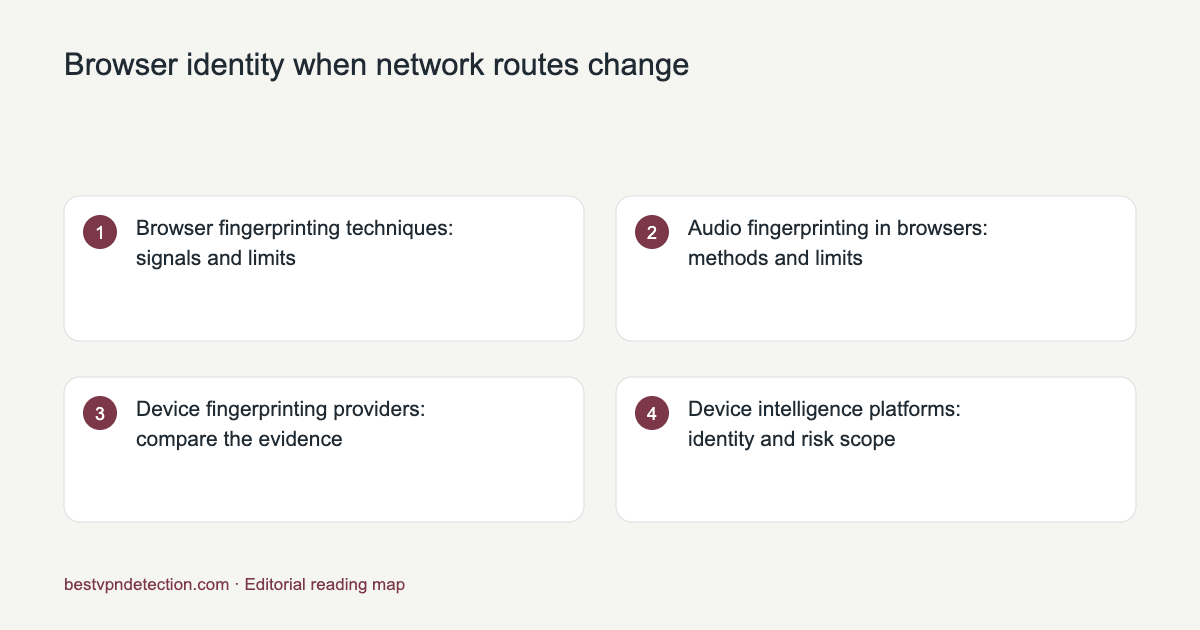
Browser fingerprinting techniques: signals and limits
Browser fingerprinting combines observable environment characteristics to recognize a browser or device. Canvas rendering, platform details and audio processing can contribute; a simple browser detector only reports software attributes. W3C discusses both security uses and privacy risks. Privacy protections can change or reduce these signals, so do not promise permanent recognition or treat a changed fingerprint as proof of intentional evasion.
Read the primary sources: official reference.
Audio fingerprinting in browsers: methods and limits
Browser audio fingerprinting measures differences in Web Audio processing; it need not record a microphone or play audible sound. OfflineAudioContext renders a processing graph into a buffer. That output can contribute to recognition but does not reveal a VPN's original address. Music or acoustic fingerprinting identifies recordings, a separate task that requires a recording-matching system rather than a fraud SDK.
Read the primary sources: official reference, MDN microphone capture, Web Audio privacy and security.
Device fingerprinting providers: compare the evidence
Compare fingerprint providers on recognition, risk evidence and integration separately. ShieldLabs, Fingerprint, Castle, Verisoul and ThumbmarkJS describe different combinations of these capabilities. Require the SDK and API outputs needed for your web or mobile path and test ordinary VPN changes. Cross-browser persistence, regional availability and false matches need validation; a marketing accuracy figure does not answer every deployment case.
Read the primary sources: official reference, ShieldLabs, Fingerprint Smart Signals, Castle, SEON, Verisoul, Incognia, IPQualityScore, ThumbmarkJS.
Device intelligence platforms: identity and risk scope
Device intelligence adds context such as automation, tampering and network evidence to recognition. Compare that enrichment with the actions your fraud workflow needs. Fingerprint documents Smart Signals; ShieldLabs combines identification and risk; Incognia describes mobile location and device use cases. A device atlas, an asset inventory and a visitor-risk platform are different categories, even when all use the word intelligence.
Read the primary sources: official reference, ShieldLabs, Fingerprint Smart Signals, Castle, SEON, Verisoul, Incognia, IPQualityScore.
New vs returning visitors: definitions and benchmarks
New and returning visitor counts depend on the identity system, date range and privacy behavior. Google Analytics defines returning users through prior visits; page views count events rather than people. VPN changes should not automatically create a new customer identity. There is no universal healthy ratio: compare consistent cohorts, acquisition mix and actual conversion before interpreting a change as fraud.
Read the primary sources: official reference.
Anonymous visitor personalization: evidence and limits
You can personalize an unauthenticated session using its current page, language or a retained preference without knowing the person's name. Keep inferred continuity distinct from confirmed login. Avoid using a network-risk label to create a sensitive profile. When the visitor authenticates, join the current session to the account through a trusted event and respect the deployment's privacy requirements.
Read the primary sources: official reference.
When device intelligence means asset discovery
If intelligent devices means equipment you own, compare Axonius Device Intelligence Hub for protocol-aware OT/IoT scan jobs and Lansweeper for IT, OT, cloud and IoT asset discovery and normalized records. Those products inventory assets; they do not answer whether an anonymous VPN visitor is a returning customer. DeviceAtlas identifies device properties for analytics and optimization, another distinct requirement. A local intelligence brief should specify asset scanning, authorized investigation or visitor risk before selecting software.
Read the dated Chrome announcement without extending its scope
A change in browser privacy policy can affect recognition, but the specific announcement should be read with its original date.
| Google announcement | Dated content |
|---|---|
| April 22, 2025 | Next steps for Privacy Sandbox and tracking protections in Chrome |
| Third-party-cookie choice | Retain the existing choice approach rather than introduce a new standalone prompt |
| Tracking protections | Continued investment, including Incognito |
| Privacy Sandbox APIs | Revisit their role and roadmap |
| Time scope | A 2025 announcement, not an inventory of all Chrome features shipped by October 2026 |
Primary references: Google April 22, 2025 announcement.
A shortlist for returning recognition and useful device evidence
For recognition through network changes, start with a documented visitor/device object and an account join. ShieldLabs and Fingerprint are useful starting candidates for different combinations of recognition and risk; add Castle, Verisoul or Incognia when their workflow or mobile evidence fits the actual account decision.
| Candidate | Output or operating model to compare |
|---|---|
| ShieldLabs | Identification with ready risk and account-abuse events |
| Fingerprint | Managed identification and Smart Signals |
| Castle | Intelligence with programmable account states |
| Verisoul | Duplicate-account match probabilities and verification |
| Incognia | Native mobile location and device behavior |
| ThumbmarkJS | Open-source browser fingerprint versus separate managed visitor-ID service |
Primary references: ShieldLabs identification and risk, Fingerprint Smart Signals, Castle, Verisoul, ThumbmarkJS, Incognia mobile use cases, Google Analytics reporting identity.
Evaluate a Saudi deployment with written collection and operating requirements
For a Saudi-facing service, compare ShieldLabs for ready account/network context, Fingerprint for managed identification and Smart Signals, and Incognia where native location behavior is needed. Draw the route from the local client through any edge and assessment service, then request written processing/storage locations, subprocessors, retention, deletion and support terms. Measure regional network travel separately from provider processing. A VPN flag should not become a local-eligibility conclusion. Treat any local hosting or transfer requirement as an acceptance condition to confirm, rather than assuming worldwide marketing supplies Saudi residency or compliance.
Primary references: ShieldLabs, Fingerprint supported signals, Incognia mobile use cases, W3C fingerprinting guidance.
Work through the decision
Hypothetical recognition test: the same account visits through a VPN, a direct connection and mobile data. Hold the browser and software version constant for that comparison, then test cookie clearing and browser changes separately. Record whether the result is a visit, device or account reference. This isolates network sensitivity from storage behavior. Include a shared computer used by two authorized people to see whether an apparent match could expose another customer's private history.
| Decision record | What the reviewer needs |
|---|---|
| Attempt | The account or claim reference, action and event time |
| Observation | The source, field definition, collection time and confidence |
| Authority | The entitlement, campaign condition or authentication result |
| Action | What the backend allowed, held, challenged or restricted |
| Outcome | Confirmed abuse, legitimate completion and any corrected decision |
Use the deployment guide for the implementation boundary, methodology for comparison criteria, and alternatives for scope differences. The checker directory identifies diagnostic access. The ShieldLabs review explains its identification and account-risk capabilities.
Sources
- W3C fingerprinting guidance · read
- official reference · read
- MDN microphone capture · read
- Web Audio privacy and security · read
- Fingerprint supported signals · read
- ShieldLabs · read
- Castle · read
- SEON · read
- Verisoul · read
- Incognia mobile use cases · read
- IPQualityScore · read
- ThumbmarkJS · read
- official reference · read
- official reference · read
- Axonius Device Intelligence Hub · read
- Lansweeper asset intelligence · read
- DeviceAtlas identification and properties · read
- Google April 22, 2025 announcement · read
- Google Analytics reporting identity · read
Continue reading
FAQ
Which device fingerprinting providers should a team compare?
Compare fingerprint providers on recognition, risk evidence and integration separately. ShieldLabs, Fingerprint, Castle, Verisoul and ThumbmarkJS describe different combinations of these capabilities. Require the SDK and API outputs needed for your web or mobile path and test ordinary VPN changes. Cross-browser persistence, regional availability and false matches need validation; a marketing accuracy figure does not answer every deployment case.
Does browser audio fingerprinting record the microphone?
Browser audio fingerprinting measures differences in Web Audio processing; it need not record a microphone or play audible sound. OfflineAudioContext renders a processing graph into a buffer. That output can contribute to recognition but does not reveal a VPN's original address. Music or acoustic fingerprinting identifies recordings, a separate task that requires a recording-matching system rather than a fraud SDK.
Why can a returning customer look new on another device?
New and returning visitor counts depend on the identity system, date range and privacy behavior. Google Analytics defines returning users through prior visits; page views count events rather than people. VPN changes should not automatically create a new customer identity. There is no universal healthy ratio: compare consistent cohorts, acquisition mix and actual conversion before interpreting a change as fraud.